Friday, February 28, 2014

Wild walks to school

Mornings in term time are hectic. I get up earlier and earlier in order to try and get out of the house on time, but always end up with the last minute rush to get to school. School is only a ten minute walk away, but with Harry it could take anything up to an hour if I let him!
Most mornings, the walk involves me quoting one of my favourite songs of the punk era "Hurry up Harry, c'mon", while Harry dawdles and stops to look at sticks, or disappear into holes in hedges.
This morning, however, I left a whole half hour earlier and let Harry follow his nose, so to speak.
I think kids are fascinated by the world around them. It doesn't take long for a sleepy five year old to fire up his imagination and enter a world of magic, danger and intrigue. Today I went with him and it was amazing.
"STOP!" Yelled Harry. "BLOW!"
I thought he had gone mad.
"BLOW! Like a dragon does!"
I breathed out and he squealed with excitement.
"You're a dragon like me! I can see you breathe smoke!"
The cold air made puffs of our hot breath and the adventure was underway. I was Purple Dragon and Harry was Red Dragon, due to the colour of our coats. Together we burnt tiny villages and towns, but stopped to watch a worm on the pavement.
"I think that's his head, and that end is his tail." Harry Red Dragon was completely absorbed, crouching over the worm as his school friends walked by.
"We must rescue it from the baddy worms and it might get squashed by feet too!"
He tried to pick it up, but wasn't too chuffed with the way it contorted in his fingers. Purple Dragon stepped in to put the worm on a patch of ground away from feet and baddies.

Next stop, the park. Purple and Red Dragon were amazed to see piles of twigs and branches blown down in the last storm.
"I am going to pick up that one myself" purred Red Dragon as he sauntered over to the largest, lichen covered branch. And he did.
When we got to school, Red Dragon told one of the mums about his adventure and when he told her about picking up the BIGGEST branch in the park, she replied "Wow Harry, you must be, like, one of the strongest boys in the world!"
That was the most perfect thing a relative stranger could say to my boy. I saw him swell with pride and a huge smile took over his entire face.
On the way home, Red Dragon found his giant branch and played with it some more, before finding a hiding place for it in the hedge.
"I hope it's there on Monday."


Thursday, February 27, 2014

Getting outdoors in 2014

Introducing little Katy!


Time has flown and I am now the proud parent of five year old Harry and 11 month old Katy. However, life is so hectic that we have had little time to get outside for adventures. As a result, Harry is fast becoming an indoor boy, often glued to the TV or computer for hours on end. How has this happened?!
I spend my working life campaigning to get more kids outdoors, I train teachers and youth group leaders on simple ways to spend more time out of the classroom, so I should be ashamed of myself, right? Well, it turns out that I am not alone. In order to pay the bills and afford the roof over our heads, my husband and I have two jobs each and often work over 100 hours a week. So, while I am out telling others to get out, my kids are waiting indoors until I get home.
Something has to change.
From now on, I will be blogging about my attempts to add more adventure into our lives and how that affects us as a family.
There will be a blend of professional with personal. Activity ideas and stories, places to go and links to good resources, all with a family feel.


Sunday, January 13, 2013

New year, new beginnings

What a start to 2013! I am about to launch "My Climbing Tree" as a new business. It's taken a lot of thought, but my simple aim is to connect communities to wildlife at a grassroots level.
This means I will be getting out the maps and discovering local allotments, school growing projects, Forest Schools and walking groups. Anyone who values their plot of greenspace can get involved...
Is there a way to link all of these spaces together? How do we turn small green plots into large, snaking and vibrant green splodges all over our towns and countryside?
I shall be running events, creating new projects and supporting existing ones: all with the aim of linking up and strengthening our fragmented communities, habitats and wildlife.
So if you would like to be involved this year, keep watching this space for details of upcoming events- some of which I promise will be unusual and an awful lot of fun! Here are a few clues- slugs, mud, chocolate, campfires, wild walks, barn owls, picnics and crafty sessions..plus much more.
I am based in Shropshire, UK so I am starting from where I know best. However, the more I talk to people, the more connections I find. I'm pretty sure that the "My Climbing Tree" network will soon spread far and wide.
I will also share some of my favourite places to go, inspiring people I meet, plus some great activities to get all ages outside exploring your local area.
Please share your experiences with me too. What do you and your family like doing? Tell me about the plants and animals near you, link your blog to mine and let's get talking!


Oh and I am due to have another baby in 5 weeks! Happy New Year!

Sunday, June 10, 2012

...Lower Wallop...


I'm in love with a farm. Last September I met the Roberts family who live at Lower Wallop. They have three hundred acres of organic food, semi-ancient woods, bats, barn owls and otters.
I haven't felt able to blog for a month, as I've been so busy exploring the farm and helping Angus and Mandy open their farm gates to the local community. Six months of planning led to an event called a BioBlitz.
iSpot.org.uk sponsored school children, families and professionals to take part in over 24 hours of continuous wildlife recording. Over 200 people, 16 different organisations and at last count over 300 species.
We're still recovering, but we're so proud of what we've achieved. We can't wait to do more and are already hoping to run another event later this year. Isn't it a great name for a farm too?


Peter keeping the kids happy with gruesome tales of bones.


Recording well into the night: the BioBlitz bat walk.

Monday, May 07, 2012

...dawn chorus...


On Saturday morning I went to work at 3.30am, just as the pubbers and clubbers were going home.
The aim of my early start was to help lead a dawn chorus walk in the heart of Shrewsbury.
Watching the sun come up while listening to blackbirds, robins and many other birds sing their hearts out is always a magical experience; especially when the walk finished with a slap up breakfast at the Peach Tree Cafe!
Twenty-five people joined me on the walk, the youngest was 11, the oldest in their 70s. Many of the group had never done any wildlife watching before. I love these events and am always impressed that so many people turn up.
What a great way to start the day.

If you want to take part in a dawn chorus, visit the International Dawn Chorus Day website.

You can cheat and listen to the dawn chorus at anytime of the day with birdsong radio!


Friday, May 04, 2012

...planet earth playdough...


H wanted to wear his spiderman suit and make saltdough today. "Why not?" I said and we rolled up our sleeves, stuck out our tongues and got mixing.
I have a basic, chuck it in a bowl without much measuring recipe which is:
1 cup of salt
2 cups of flour
lukewarm water
food colouring, including turmeric for yellow.

H wanted a ball each of yellow, green and blue.
Then he pounced on them and mashed the three balls together, disappearing into a 3 year old boy's fantasy world of a dinosaur's tea party.
"Look Mum!" said H after a quiet moment "urff! Where we live."
Blimey. He was right. There in his hand was a playdough blob that looked uncannily like planet Earth.
Madness.
I'm ashamed to say that I was a sad mother and leapt up, grabbed the dough and took many pictures before handing it back to become squashed into a dinosaur cake once more.

Here's the result. Isn't it weird?


Thursday, May 03, 2012

...rain and rhubarb...


The relentless warm rain makes the garden look amazing. The lawn is a rainforest and the rhubarb looks the happiest its been in ages. I cut the first crop of the year and made rhubarb and custard using a recipe from Hugh's River Cottage Veg Everyday!

My favourite way to eat rhubarb is stewed with orange juice and eaten warm with shreddies.
My mum loved that too. She was a keen gardener and loved growing food we could all tuck into.
The taste is so different when you've grown it yourself isn't it? Sunshine and soil.

Sadly my lovely mum died eighteen years ago, and there are still days when I miss her like mad. But by growing veg for my own family I'm connecting with her all the time and kind of filling that big gap. She would love my garden. So here's a bowl of rhubarb and shreddies to you mum, and absent gardeners everywhere.


Tuesday, May 01, 2012

...power to the people...


Just got back from a lively Place Plan meeting in Shrewsbury.
It wasn't at all boring and there was no jargon.
(well, not much anyway)

What I liked about it was that developers (in some very sharp suits), local residents, local charities, gardening and allotment groups, ecologists and planners all got together in one room and talked to each other.

Meetings like this could potentially see the end of absentee development firms slapping large-scale bland development on local communities.

If more people get involved, Place Plan meetings could be the start of more useful relationships between smaller development firms and the communities that host them.
A lot still has to happen, but I could see the beginning of something better and a bit less shouty.
People might not like what the developers propose, but then at least we can openly and respectfully challenge it.

The residents of Corner Farm Drive were all there tonight making their voices heard. (Hooray!)
Oo, there were some meaty discussions going on in the Corner Farm corner.
A neighbouring community group came to say hi. We had a chat and shared ideas.
One of these ideas is to link our greenspaces together to make a really big wildspace round the edge of Shrewsbury.
The proposed developer thinks their new "Country Park" could be just 15 metres wide.
That should make for some nice long thin picnics.
Can you see how these discussions start?
The key thing here is that if local communities don't care, then the developers will only ever do the absolute minimum to get the maximum profit. Who can blame them when it's "good business sense".

Trouble is, it doesn't make good mental health sense, good community health sense, good natural health sense, good family financial sense, good long term or short term sense. But if no-one is willing to point this out, then we only have ourselves to blame.

CBT is a self feeding, sustainable idea. Get outside and climb a tree or have a picnic. Take your dog for a walk (clear up the poop!) or just sit in a greenspace and read. Fly a kite. Stare into the middle distance.  Please don't just look at wildlife through your window, you will lose it. It's real and needs you to value it.
I guarantee the magic then starts. More people will see you valuing your greenspace and think it must be OK. They join in. Talk to them. Start to record the wildlife you see, take pictures and share them with others. This is what technology is for.
Now, what happens if developers want your land? If enough of you have come together to protect your space for a long enough time, you can do things to look after it.
If you think you will need to compromise, then start now to put yourself in the driving seat. Make developers make your space even better in ways that excite you, not depress you. Hell, they'll even pay you to do it for them.

Tuesday, April 24, 2012

...a wildlife pond...

Tadpoles. Very hungry tadpoles. It's time they got a place of their own...

...back at the beginning of the year, I wrote about all the things I really wanted to create in my garden. One thing on the list was a wildlife pond. Well, we've gone and done it! With a lot of help from our lovely friends Mark and Caz, plus the neighbourhood kids, we've put together a very cute little pond.
It was so easy! The whole thing took a couple of weeks (off and on) and cost about the same as a tank of petrol (£55). If you'd like to make one for the same price, the dimensions are 250cm x 170cm, with a depth of just over 70cm.
H and I have also been looking after some extremely hungry tadpoles; this pond will be their new home. We're very excited and can't wait for relocation day. I'll do another update when I put the edging in and create other features like a marsh and beach.

Pond Conservation are a national charity dedicated to the protection and creation of freshwater habitats for wildlife. Find out more about them at http://www.pondconservation.org.uk/

I've downloaded their free book "Creating Garden Ponds for Wildlife", which should give me a good idea about how to plant up the pond and manage it in the future.

Thursday, April 12, 2012

...flowers and fierce beasties...


This is Mark. He knows his plants. He came to explore the wild patch and found over 90 species of plant. This is brilliant, considering the weather wasn't great, and it is still quite early in the year. His records have been put on our community spreadsheet and will be passed on to the VCR (Vice County Recorder) that way, the records become official.


Meet Ian. He knows his "bugs". His specialist subject is bees, ants and wasps, but he knows a little about a lot of other invertebrates too.
On a dull,overcast day in April, he found 8 species of ladybird, countless flies, numerous spiders and a plethora of bees. All of which will become official records for the site when submitted to the VCR.


Now you think that would be enough for one day. But it wasn't. Not only did they volunteer to come over and help out, they stayed all day, met the neighbours and shared their knowledge with local, very interested families. GJ, aged (nearly) 4 took an instant shine to Ian as they both shook tree branches with large sticks in order to dislodge the insects living on them. GJ bounced, shook the branches and then stood completely still, mesmerised as Ian and Mark showed him what they'd caught.

This is what I mean by CBT (Community Biodiversity Training). Ordinary people coming together to value a local piece of land and learn about it, in order to protect it in the future. Good people like Mark and Ian are out there, near you just waiting for you to ask them over.

...there is a Place Plan meeting due on the 1st May to discuss larger-scale developments in Shrewsbury. It will also (hopefully) be a chance for us to air our views and share what we've discovered so far about the wildlife and community on Corner Farm Drive.
I would really like this whole experience to be positive, informed and constructive. It is very hard to remember this sometimes, so excuse me if I rant occasionally!
Can you spot the spider?


 I am learning so much about planning, communities and wildlife- it's woken me up to the wildlife on my own doorstep, so much so that even a fly in my cup of tea gets identified and added to the list! (You think I'm kidding? I rescued a Notiophilus biguttatus from my mug just an hour ago).

Would anyone like me to try and put together a toolkit for other communities in similar situations? I can't promise it will be perfect, but it might help you get started on your own "Community Biodiversity Training"! Comment to let me know what you think and what information you'd like to see.

Hope you all had a good Easter break?

Monday, April 02, 2012

...wildlife at Corner Farm...

Just a quick update to let you know that over the last few days of sunshine we've seen more of the following:

Butterflies...
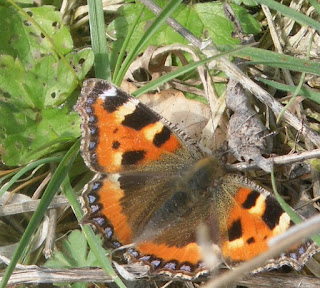
...orange-tip, peacock, small tortoiseshell, brimstone, red admiral and holly blue...

Birds...
Chiffchaff, garden warbler, rook, crow, blackbird, robin, bullfinch, chaffinch, greenfinch, bluetit, great tit, coal tit, blackcap, dunnock, wren, house sparrow, song thrush, pheasant, red-legged partridge, greater spotted woodpecker, buzzard, jackdaw, wood pigeon...

Invertebrates...
Woodlouse, nursery web spider, orb web spider, wolf spider, crab spider, bee fly, centipede, slug, snail, 2-spot ladybird, 7-spot ladybird, 22-spot ladybird, harlequin ladybird, caterpillars, hoverflies, buff-tailed bumblebee, white-tailed bumblebee, red-tailed bumblebee, common carder bee, red mason bee, common wasp, lacewing, ground beetle, earthworms, springtails, millipedes, beetle larvae, (plus the butterflies above)...

Mammals...
...wood mouse, house mouse, badger tracks and latrine, fox tracks, pipistrelle bats, molehills...

Flowers...
...nettle, dock, fumitory, ivy-leaved toadflax, ivy, holly, ash, oak, birch, fir, elder, hawthorn, blackthorn, common field speedwell, germander speedwell, ground ivy, lesser celandine, greater celandine, red clover, white clover, bittercress, plantain, goosegrass, garlic mustard, white mustard, sycamore, damson, willow, violets, common chickweed, mouse ear chickweed, creeping buttercup...

The total stands at 91 species, with more surveying of moths, beetles and spiders, bats and fungus over the coming months.

The local residents are having lunch together tomorrow to share our thoughts and to find out what's been going on. Mark and Ian will be there, and they're planning to search the area looking for more plants and animals.

It's not all about the species count though. It's becoming more about the stories people have of the land we're potentially about to lose. There must be a way for the existing land to be protected in the same way it's valued?

I'll let you know how we get on...

Saturday, March 31, 2012

...natural childhood...

Please read this inspiring report, realeased today by the National Trust, written by Stephen Moss. It's evidence based writing on the fact that our children are losing access to nature. Wild places are not just for the middle classes who can afford large private gardens, it should be for everyone and within easy access of where you and I live.
I went for a walk along the Rea Brook through the heart of Shrewsbury earlier and had been thinking, "Maybe I am being a nimby after all. Maybe housing and the loss of wild open space at the edge of town is OK, because green corridors will survive and be better than what we have now?"

Our walk along the Rea Brook was pretty, but it was tame, fenced in and my son got covered in dog poo as a result of exploring a little way off the footpath.
Can this type of environment be described as part of a sustainable future?
I am constantly thinking of what the councillor told me yesterday. "If developers make a profit then they must be doing something right".  Really? Is financial profit justification enough?


...nature tots...

I've been meaning to post about this group for some time. Nature Tots is a parent & toddler group that meets at Shropshire Wildlife Trust in Shrewsbury. Each week has had a different them such as frogs, rabbits - even wriggly worms as the inspiration for art, songs and other activities.
Over the past 8 years, over 400 different families have come along. We've grown our own vegetables, kept pet snails, eaten healthy snacks and composted our waste.
Nature Tots did all of this with volunteer support. Local parents and grandparents gave their time and shared their skills to great effect.
The group is taking a break until September when it will emerge as something slightly different. Call it a pupation, or hibernation if you like. The volunteers all need a break to do something different with their own kids for a while.

At our last session we made felt shapes from raw sheep's wool. Oscar (4), told us a story about a spider he found on his bed that morning, so we thought spider pictures would be a good thing to make from the wool.

If you want to have a go yourself all you need is some sheep's wool (2 different colours minimum), cardboard, bubble wrap and hot soapy water.

1. Decide on the picture you want to make and lay out some wool to form the background.
2. With different coloured wool, lay out the picture you want, with the fibres running in opposite directions to the background.
3. Place the whole thing onto a layer of bubble wrap, bubble side up.
4. Spray the whole thing with hot soapy water
5. Put another layer of bubble wrap over the top, bubble side down.
6. Rub the top layer of bubble wrap, gently at first so as not to disturb the wool picture below.
7. As the fibres start to knit together you can rub harder until the picture is felted enough for you to pick up, without it falling apart.
8. You may need to add more hot water to encourage the wool fibres to felt.
9. Have lots of messy fun!

Nature Tots will be back - and will more than likely be outdoors a lot more. If you are a Nature Tots mum or dad reading this, send a comment, share your ideas and let's get planning for the autumn!

A felt spider

Felt making at Nature Tots

Friday, March 30, 2012

...chocolate beetroot brownies...

A break from the usual ranting today! We've had the best time playing in the garden with my good good friend Anita, and her bubbly little girl, D. We girls needed a treat so I found this recipe for the most incredible chocolate beetroot brownies from Riverford, via Emma Bradshaw's beautiful blog. Oh my, these cakes are good. Eat them warm and let them melt in your mouth.


Chocolate beetroot brownies
Cheeky...


Dough sticks on the campfire
Bouncing on next door's HUGE trampoline

Cooking our dinner out in the garden


Time for a spot of face painting

...insect hotel...

Here's a great idea for your back garden or green patch. I found this design for a high rise insect hotel over at metrofieldguide.com. They're striking to look at and very easy to make.

You'll need:
4 pallets (minimum).
Try to get them all the same size and remove any nails and large splinters.
Flat, even ground, preferably in a half sheltered, half sunny spot.
Birch logs
Hazel poles,
Bamboo canes
Straw or hay
Dead leaves
Corrugated cardboard
Plastic bottles with the bottoms cut off
String
A drill and 5mm bit
Terracota pots
Tins
Garden prunings
Small pots of wildflowers

Set the pallets, one on top of the other, in your chosen location.
Start to fill the gaps between the pallets with the materials you've gathered. Drill some small holes in the faces of your birch logs too. These will attract mason bees, a brilliant addition to any garden.

You can then top it off with a roof of slate, turf or sedum and stand back to watch the insects move in! Within a few days you'll have ladybirds, spiders and solitary bees.

Why do it? It looks attractive and will attract lots of beneficial insects to your garden. It needn't cost anything either, if you use old bricks, pots, cuttings and prunings.
If you work in a school or community setting you could ask for contributions to the insect hotel from lots of different gardens.

This one was made in Ellesmere yesterday, with pallets donated by Tudor Griffiths in Ellesmere. Volunteers from the Ellesmere branch of Shropshire Wildlife Trust were there, plus the church warden, sunday school teacher and local residents. It was an inspiring day, (thank you!), especially meeting everyone and having a giggle. I'll be popping back to take some more pictures in the summer to show you how it's progressing.

Alex, Robin and Richard all getting stuck in
The (nearly) finished hotel


Thursday, March 29, 2012

...a number in a plan...

Have a listen to this report on the Today programme on Radio 4 (27th March 2012).
In principle, involving communities in planning, right now, from the outset is the way forward.
Trouble is (and be honest!), are you relishing the prospect of planning meetings to discuss zebra crossings, industrial estates and housing allocations?
No, I thought not.
And I really think this lack of interest and confidence is what developers are counting on.
My personal concern is that without mentoring and "CBT" (Community Biodiversity Training) to create well-informed communities, the developers get to decide what's in the public interest all over again. CBT would include bug hunts, bat walks, campfires, wild food eating and games of hide and seek. This is my kind of planning.

I'd be interested to know your thoughts too.

Here's one opinion I heard today:  "If developers are able to make a profit, then the fact that the profit exists means they must be doing something right".

This was from somebody with an ability to make a decision on behalf of many, many people.
I recognise the need to feed my family and so, yes, profit can be good.

However, financial gain for one small company is one thing.
Net loss of biodiversity and community access to wild spaces; the subsequent increase in car use, busy roads, poor mental health, litter, pee-filled bottles, obesity, isolation, habitat fragmentation, less water, more flooding... are all long term, hard-to-calculate costs of insensitive development, regardless of whether it's called "sustainable urban expansion".


This is conveniently overlooked when making the economic calculations.

If someone wants houses or industry then biodiversity is easy to ignore, especially if local communities leave it to other people to record and notice on their behalf.
There's a mutual ignoring of wildlife, or worse still, a taming of it in play parks and landscaping. Wildlife-free housing estates with road names like "Sparrowhawk Way" and "Green Lane" are all our futures if more of us don't turn off the telly and actively celebrate wild green patches everywhere.


Please go for a picnic this weekend?

Wednesday, March 28, 2012

...sunshine...

...All this sunshine has brought the wildlife on the farm bouncing and buzzing into action. Just sitting in my garden yesterday I saw hoverflies, 4 different types of bumblebee a Brimstone butterfly, the first chiffchaff and later that evening a pipstrelle bat flying so low over the hedges that at times I was tempted to reach up and grab him!

A Field Blewit
The unofficial wildlife list is nearing 200 species and counting. I've been talking to some experts and asked them to come over to have a "root around" the wild patch. In future posts I'll be introducing you to "Paul the Moth Man", "Ian the Bee Man" and "Pete the Invertebrate Challenge Man". They are all experts in their fields and have very kindly agreed to help us discover more about the farm's wildlife. They'll only come along though, if locals come out to discover what's here too.
That shouldn't be too hard.
I think the "Corner Farm Kids" will love a few late nights camping out and looking for moths, detecting bats with a bat detector and running around the field collecting bugs for Pete and Ian to identify.

Nature shouldn't be left to a few experts. Are you a teacher? Do you fancy teaching a new subject? CBT. Community Biodiversity Training. Think of the power you'll give future communities when faced with insensitive development.

Oh, and I showed some of the amazing mushrooms we found on the field to John Hughes, a rather lovely man. He was so impressed. We have Field Blewits - with bright purple stems. They shouldn't be out at this time of year, but he thinks that as last autumn was so rubbish for fungus, they may have residual energy stored up for more suitable weather conditions. The Field Blewits are making up for lost time and putting on a spring show. It's not that common a species either.

I'm summing up the courage too, to speak to the developer of the proposed housing estate. It's time we had a good chat....eek!

Tuesday, March 27, 2012

...freedom and mice...

...we've had the best weekend.
Misty, dew-drenched mornings and long hot afternoons made the weekend feel just like an adventure straight from the pages of Famous Five.

Every time I went out looking for plants and animals, neighbours I've never spoken to before leaned across fences to introduce themselves. "This tree is my favourite" said one neighbour, "but I suppose I can't do anything about it, it'll have to go."

It may sound strange, but we're all experiencing a kind of grief.
It's more than just a fear and mistrust of change. It's a real body-blow of loss.
We might not be able to give the trees latin names, or wax lyrical about complex ecosystems; but I've noticed neighbours paying a quiet respect to the land that's about to be built on.
There's no wringing of hands or drama; more deep sighs, long pauses and a lot of looking.

Humans exist to connect. Humans connect to each other, but we also connect to the world around us. This connection goes deep. Think back to where you played as a child, escaped from parents' rules, or even stole your first kiss from the one you loved!

Your childhood playspaces may well have been built on already and if so, I'm sorry.
This is happening all the time to successive generations.
There's a constant erosion of wild because communities feel powerless in the perceived face of large corporations and the "march of progress".

I'd really like to take an honest look at the nature of progress and its impact on our relationship to wild.

It starts with sharing with you what we already have...

So here we go, a run down of all the wildlife we've found over the last few days,and it really is we, not just me.

(When I popped outside last night to put H's toys away, there were next door's kids, W and O, running around the field collecting leaves, bark and flowers in a plastic pocket. When W saw me he shouted - "I didn't want you to miss anything!" So I've started a scrapbook and nature table, full of all the things we find).

Here's a taster...
Corner Farm Wildlife (21st-25th March 2012)...

Elder, Ash, Sessile Oak, Hazel, Hawthorn, Blackthorn, Goat willow, Crack willow, Holly, Ivy, Sycamore, Damson, Brambles, Dandelions, Daisies, Goosegrass, Chickweed, Germander Speedwell, Common Field Speedwell, Red Deadnettle, Stinging Nettle, Yorkshire Fog, Angle Shades Moth, Tortoiseshell Butterfly, Peacock Butterfly, Red Admiral Butterfly, Bee-fly, Buff-tailed Bumblebee, Red-tailed Bumblebee, Garden Bumblebee, Common Carder bee, Honey bee, Wood Mice, Fox, Badger, Nursery Web spider, Crab spider, Seven-spot Ladybird, 22-spot ladybird, Banded snail, Brown-lipped snail, Garden snail, King Alfred's cakes (a fungus), Creeping thistle, Marsh thistle, Spear thistle, Red mason bee, Blackbird, Wren, Chaffinch, Greenfinch, Goldfinch, Bluetit, Great tit, Bullfinch, Song Thrush, Garden Warbler, Blackcap, Buzzard, Rook, Crow, Robin, Dunnock, Hedge Sparrow, Coal tit, Boletus mushrooms, Ink cap mushroom, Fumitory, lichens (4+species), mosses (5+ species), Pheasant, Lesser Celandine, Barn Owl, Polecat, Brown Hare, Woodlice (4+ species), Bittercresses, Clover, Garlic mustard, Common Dog Violet, Broad-leaved dock, Mouse Ear Chickweed, Violet Ground Beetle, Greater Spotted Woodpecker, Sparrowhawk, House mouse, Yellow slug, Ground Ivy, Hedge Woundwort, Black Horehound...

...oh, and kids dens, campsites, places to play, risk taking, climbing trees and freedom...

(I don't think I've repeated anything?!)
There's now a flickr stream for photos, and a community recording spreadsheet, available to anyone interested, please comment for access to a copy.

H, G, W, T and O ("The Corner Farm Kids") helped set out and collect humane mammal traps.
We found 4 traps with wood mice in the hedgerows, each was taken by the kids on a victory parade around the houses, before being released in the same area in which it was caught.

We've eaten hawthorn leaves, aka "Bread and Cheese", found buzzard pellets, watched mice, built dens by the campfire and chased a very accommodating (or daft) pheasant across the field.
Experience of freedom is just as important as learning to read and write.
Wouldn't it be great to always have access to wild green space within walking distance of where we live?

H and a Wood Mouse
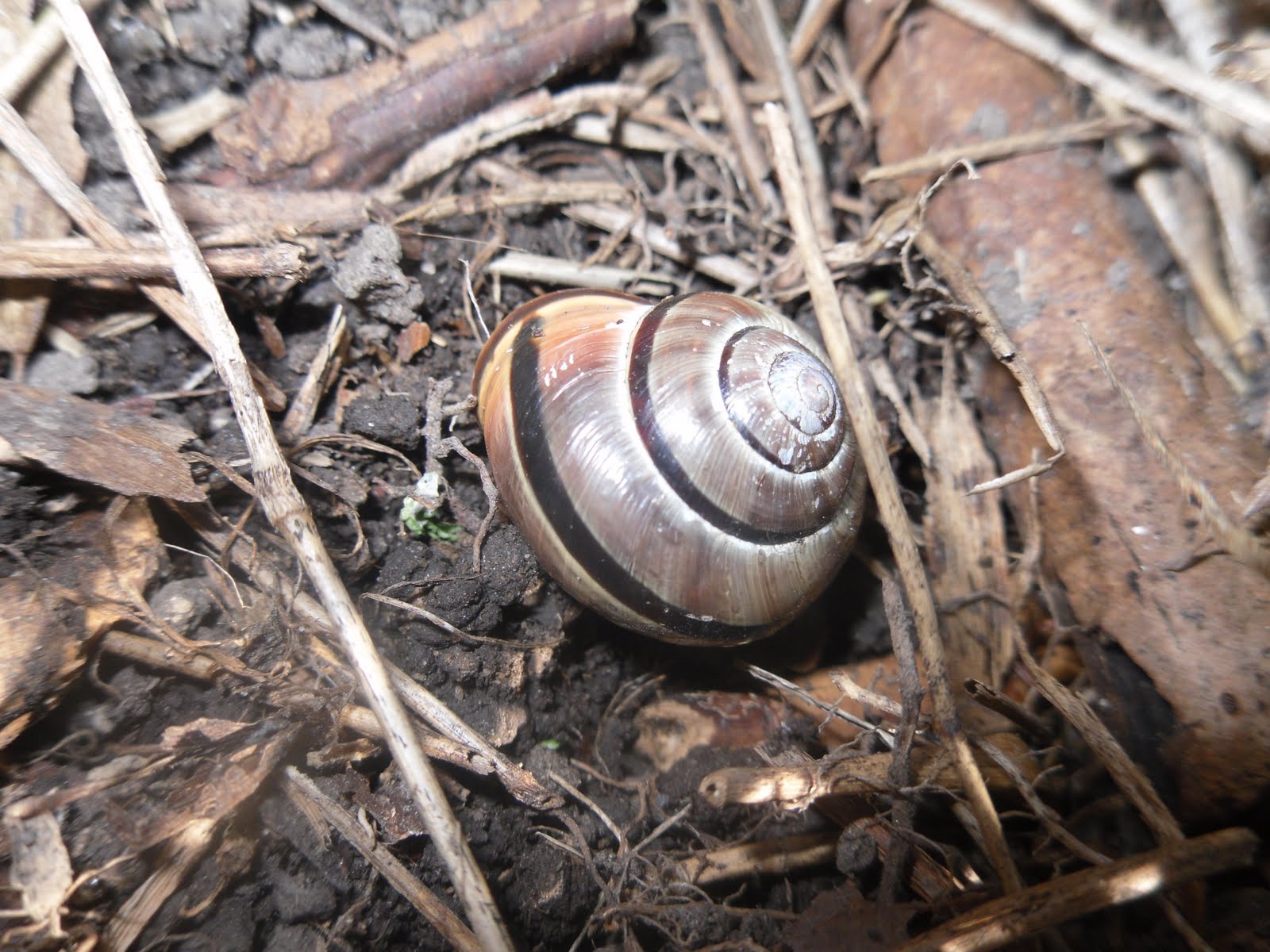
We need a snail expert! I think this is a brown-lipped snail.
An ink cap fungus? I'm still checking with the experts...


Can you spot the spider?


A well-earned campfire at the end of the day

I call these "Alexander Beetles" from stories my mum used to read me..